
Planet maemo

Andrew Flegg

MWKN Weekly News for Monday, 15 Oct 2012

2012-10-15 04:00 UTC  by  Andrew Flegg
0
0
Front Page

Non-profit board elections underway, council nominations re-opened

The election for the Hildon Foundation Board opened this past week on Friday (October 12th) and will run through Thursday October 18th 2012, 23:59 UTC. For the board elections: "Due to Nokia's state, its funding for maemo.org in 2013 is uncertain. The community is working on bylaws for a new legal entity (currently with the working title “Hildon Foundation”) that can legally inherit the domain name or have donations (monetary, hardware and/or data) from Nokia, the current providers, and community members, which can be used to continue operation of resources vital to the community. The bylaws are currently in discussion, and will be formalized shortly. The initial Board for the Foundation will be elected parallel to, and with the same election rules and requirements as, those currently established for Council elections. It is expected that the Board elected for this new entity will adopt the community's desired bylaws and be ready to take the reigns as soon as the entity is ready for operation."

The nomination period for the Maemo Community Council has been extended through Sunday October 28th, 23:59 UTC. Voting for council will take place from November 2nd through the 8th.

Read more (maemo.org)
Read more (talk.maemo.org)

In this edition (Download)...

  1. Front Page
    • Non-profit board elections underway, council nominations re-opened
  2. In the Wild
    • The Story of Nokia MeeGo
    • Samsung to merge bada with TIZEN
Kaj Grönholm

Qt5 and normal mapping - reloaded

2012-10-14 10:54 UTC  by  Kaj Grönholm
0
0
(This is part II of the normal mapping journey, check the part I first for details.)

So you have all now played with Qt5 NMapper tool, right? Goody, that means we have gained experience of normal mapping and created some perfectly tuned normal mapped textures. Now it's time to use these in a separate application.

Let's assume that you are working on a 2D QML application, but would want 3D-looking effect into some part(s) of the UI. To visualize, here's an example NMapCarousel demo application:


(Qt5 NMap Carousel, running on PC and on Raspberry Pi)

Here normal mapping is used to make the carousel icons more dynamic by applying lighting. To increase the 3D impression, there are also extra shadows reflected behind the icons.

To implement something similar, here's how to proceed:

  1. If not already, setup Qt5 to your PC/Mac/RPi or equivalent platform.
  2. Create normal maps of your graphic assets using Gimp, Blender, Photoshop etc. tool of your choice. Name the normal mapped image with extra "n" in the end, so images are something like "thing.png" and "thingn.png".
  3. Test your graphics with NMapper by copying these images into "images" folder and adding "thing" into imageFiles array property. Play with the light intensity, diffuse, switching x&y coordinates etc. If you are not happy with the results, jump back to step 2 to edit the images and iterate.
  4. Make your own application. Copy NMapEffect.qml and NMapLightSource.qml from NMapper, use your freshly made images, the lighting settings you tested earlier and implement rest of the UI.
  5. Profit! (Sorry that this took a bit more steps than normally... but on the positive side there is no unknown ???-step in the middle!)

Source codes of this demo are available from here. I'm waiting to see cool normal mapping uses!

PS: To learn shaders from the master, check out Andrew's thndl.com!

Categories: hacking
Craig Woodward

Board Elections and Council Nominations

2012-10-12 17:12 UTC  by  Craig Woodward
0
0

For those who haven't been following along with the discussion:

  • Board elections have started, and will close on October 18th.
  • Council nominations have re-opened and been extended until October 28th.

The election thread has all the details, including the new time tables.  Thanks again to MisterC for creating the candidate declaration wiki page, and to Andrew for helping with clarifications and nomination validation on the community mailing list.

If you have not yet received your token for voting, please check your spam filters and/or validate you are elegable and have a current e-mail address in your maemo.org account.


Categories: news
Kaj Grönholm

Qt5 and normal mapping

2012-10-12 12:04 UTC  by  Kaj Grönholm
0
0
This one has been on my "blog at some point" back burner for some time now...

'Normal mapping' is a graphics rendering technique used for faking the lighting conditions. In 3D software it is often used for bringing small bumps and dents of textures visible to achieve more realistic graphical appearance without using huge amount of polygons. Normal mapping is kinda advanced version of preceding 'Bump mapping'  technique. Where bump mapping uses just one channel for 'bumps', normal mapping uses 3-channel (RGB) bitmaps and can therefore contain more detailed normal vector information.

Normal mapping technique can also be used in 2D applications to get 3D'ish looking UI elements, which means it can be used also in normal non-Qt3D QML applications. Combining image textures with specifically made normal map textures using a suitable shader is all you need. And normal maps can be automatically created with Gimp, Blender, Photoshop etc. drawing tools, although for best results some tweaking may be required.

But enough about theoretical mumbling, here comes visuals:


(Qt5 NMapper tool, running on PC and on Raspberry Pi)

To experiment with normal mapping I implemented a simple Qt5 NMapper application. As seen from video, it can be used to play with different graphical assets, change lighting conditions, switch normal map x&y-coordinates etc. It also includes the essential 'cave mode' for wiggly fire light.. ;-)

Download NMapper application from here and try it on PC/Mac/RPi or equivalent platform with Qt5.

After this brief intro I'll make a follow-up post within few days about example usage. Have a hacking weekend everyone!

Categories: hacking
Andrew Flegg

MWKN Weekly News for Monday, 8 Oct 2012

2012-10-08 04:00 UTC  by  Andrew Flegg
0
0
Front Page

Jolla to unveil Mer-based Sailfish OS and developer story next month

Last week Jolla announced it will be unveiling its new Sailfish OS, Jolla UI, and SDK at the Slush startup conceference in Helsinki November 21st and 22nd: "The startup, which is comprised of many former Nokia employees, said it will also discuss the Jolla SDK and app ecosystem with developers. 'Device information, ID and expected availability' will be announced before Christmas, it added. 'I’m thrilled to finally be able to show the user interface we have been working on, and it will be exciting to open the developer story with SDK and applications to the public,' said Jussi Hurmola, CEO of Jolla, in a statement."

The reveal of the platform and developer story will be the first major non-business announcement from Jolla, and will give developers a more meaningful picture of what the application story will look like for the platform. The reveal of the Jolla-specific UI differentiation will be our first look at what Jolla's "all new" UI will look like. The release of the SDK will hopefully drum up some excitement for the platform, and it will be interesting to see what sort of information the community manages to dig out about the hardware platform (an endeavor the Maemo community is very familiar with).

Read more (techcrunch.com)

Jolla brands Mer-based MeeGo offshoot ecosystem as "Sailfish"

Last week, Jolla announced the formation of a strategic platform alliance around the newly-branded Mer-based Sailfish platform: "Finnish smartphone start-up Jolla will build a new mobile alliance which will license the MeeGo-based mobile operating system to other device manufacturers and service developers beginning spring 2013, according to Jolla CEO Jussi Hurmola. According to Hurmola, Jolla is currently building up a new 200 million euro mobile alliance based in Hong Kong, China. In the core of the alliance is the MeeGo based mobile operating system which Jolla calls "Sailfish"." No partners have been announced, and the €200 million isn't a particularly large number, but it will be exciting to see what sort of interest it manages to generate.

Read more (talouselama.fi)

In this edition (Download)...

  1. Front Page
    • Jolla to unveil Mer-based Sailfish OS and developer story next month
    • Jolla brands Mer-based MeeGo offshoot ecosystem as "Sailfish"
  2. Development
    • Updated FUSE (Filesystem in Userspace) for Maemo 5
  3. Community
    • Logs from latest Maemo Community Council meeting
xan

On advertisement and international traveling

2012-10-03 14:54 UTC  by  xan
0
0

AdBlock, integrated

For a long time our adblock story was a bit underwhelming. We had an extension to do the job, but it was buggy and it would often either not block what it had to block or block just way too much (like, the entire page). So in the last cycle we pretty much rewrote the extension from scratch: it just works better, blocks what it has to block, and uses the adblock+ source filter files.

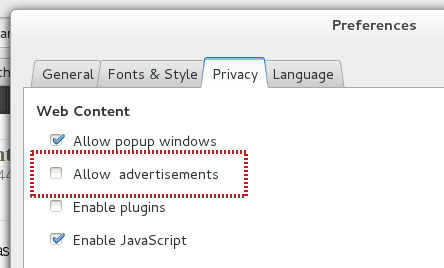
We just felt this was not enough though. Lots of people still found the wrong extension version, or were not aware there was an extension in the first place, so their experience was not as good as we hoped. So for 3.8 we are just going to bite the bullet, and integrate adblock into the browser itself. Last week we took the extension, merged it into Web, cleaned the the heck out of it, and added a simple entry point in our preferences to control it:

Of course there’s still some things that could be done, like a simple UI to edit the filter rules (for instance, to white-list a particular page where you do want to see ads), but for now we feel this is already a good improvement.

Boston Summit

In other news, I’m just a couple days away from jumping into a plane to attend this year’s Boston Summit. I’m looking forward to see old and new faces and continue the good discussions and work we started in GUADEC about the present and future of GNOME. On the selfish department, I hope to get hold of some lost designer to start fleshing out the 3.8 plans for Web, there’s so much to do.

Thanks to the GNOME Foundation for sponsoring my trip, and to Igalia for allowing me to attend the event!

Categories: Blogroll
Alberto Garcia

IndustryPack, QEMU and LinuxCon

2012-10-03 12:10 UTC  by  Alberto Garcia
0
0

IndustryPack drivers for Linux

In the past months we have been working at Igalia to give Linux support to IndustryPack devices.

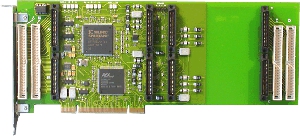
IndustryPack modules are small boards (“mezzanine”) that are attached to a carrier board, which serves as a bridge between them and the host bus (PCI, VME, …). We wrote the drivers for the TEWS TPCI200 PCI carrier and the GE IP-OCTAL-232 module.

TEWS TPCI200 GE IP-OCTAL-232

My mate Samuel was the lead developer of the kernel drivers. He published some details about this work in his blog some time ago.

The drivers are available in latest Linux release (3.6 as of this writing) but if you want the bleeding-edge version you can get it from here (make sure to use the staging-next branch).

IndustryPack emulation for QEMU

Along with Samuel’s work on the kernel driver, I have been working to add emulation of the aformentioned IndustryPack devices to QEMU.

The work consists on three parts:

  • TPCI200, the bridge between PCI and IndustryPack.
  • The IndustryPack bus.
  • IPOCTAL-232, an IndustryPack module with eight RS-232 serial ports.

I decided to split the emulation like this to be as close as possible to how the hardware works and to make it easier to reuse the code to implement other IndustryPack devices.

The emulation is functional and can be used with the existing Linux driver. Just make sure to enable CONFIG_IPACK_BUS, CONFIG_BOARD_TPCI200 and CONFIG_SERIAL_IPOCTAL in the kernel configuration.

I submitted the code to QEMU, but it hasn’t been integrated yet, so if you want to test it you’ll need to patch it yourself: get the QEMU source code and apply the TPCI200 patch and the IP-Octal 232 patch. Those patches have been tested with QEMU 1.2.0.

And here’s how you run QEMU with support for these devices:

$ qemu -device tpci200 -device ipoctal

The IP-Octal board implements eight RS-232 serial ports. Each one of those can be redirected to a character device in the host using the functionality provided by QEMU. The ‘serial0‘ to ‘serial7‘ parameters can be used to specify each one of the redirections.

Example:

$ qemu -device tpci200 -device ipoctal,serial0=pty

With this, the first serial port of the IP-Octal board (‘/dev/ipoctal.0.0.0‘ on the guest) will be redirected to a newly-allocated pty on the host.

LinuxCon Europe

Having virtual hardware allows us to test and debug the Linux driver more easily.

In November I’ll be in Barcelona with the rest of the Igalia OS team for LinuxCon Europe and the KVM Forum. I will be talking about how to use QEMU to improve the robustness of device drivers and speed up their development..

Some other Igalians will also be there, including Juan Suárez who will be talking about the Grilo multimedia framework.

See you in Barcelona!

Categories: Debian
Henri Bergius

On tablets and productivity

2012-10-02 22:47 UTC  by  Henri Bergius
0
0

Tablet usage is growing rapidly. Ars Technica wrote about an interesting study today:

Click to read 1618 more words
Craig Woodward
This is a review of the weekly meeting of the Maemo Community Council.

Meeting held on FreeNode, channel #maemo-meeting (logs)
Attending: Woody14619, Ivgalvez, NielDK, SD69

Summary of topics (ordered by discussion):

  • CC status
  • Elections
  • Bylaws updates and NFP status
  • Council Mailbag (QT5 competition related)
  • Misc topics

Topic 1 (CC Status)

  • Elections for CC are finished, organizers are working on finalizing results.
  • See the official wiki page for links and eventual official results.

Topic 2 (Elections)

  • We have enough candidates to move forward, nominations end the 28th.

Topic 3 (Bylaws and NFP status)

  • Updates from Woody and TMO are posted in TMO.
  • We now have a tax-ID number.
  • Woody has had no time to work on getting bank account setup.
  • We need to chat with Nokia/Nemien to do further setup for transition.

Topic 4 (Council Mailbag)

  • Laszlo Papp requests Council attempt to recall/redistribute awards from QT5 competition from earlier in 2012, as he feels recipients have not promoted QT5 as the award required.
  • After consideration, this was a Nokia-run competition which Council was not involved in. Council feels it would be inappropriate to interject itself into the QT community (which is much larger than Maemo, Harmattan, and/or MeeGo).
  • It is decided we will encourage Laszlo to take this matter up with the Community via TMO. If there is a consensus there, the next Council may revisit this topic.

Topic 5 (Misc/reminders)

  • We continue to have infrastructure problems, hopefully resolvable by Hildon Foundation when we/if they get the keys.
Categories: news
José Dapena Paz

As part of my work at Igalia browsers team, I am working on making WebKitGTK+ and Epiphany work on Wayland.

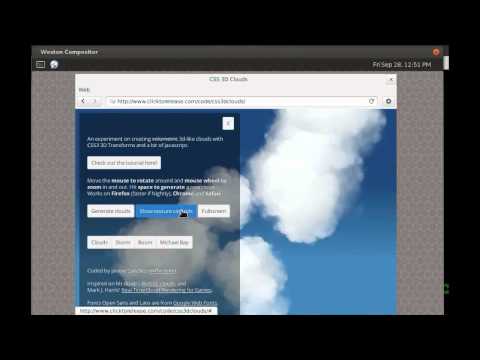
Just running non 3D websites on Wayland did not involve too much work. But running the OpenGL accelerated code in WebKit was a bit more complicated. Though, I’ve got a first working version.

Video: Epiphany on Wayland running WebGL and CSS-3D

On WebKitGTK+, we enable the use of hardware acceleration with OpenGL for:

  • WebGL: web pages with a canvas using WebGL are run using the 3D hardware available.
  • Accelerated composition of layers. With stuff like CSS-3D transformations, 3D hardware acceleration is handy to composite the layers of a webpage.
You can read more about accelerated compositing on these posts from Martin Robinson: WebKitGTK+ hackfest wrapup, and Accelerated compositing update.

On X11, we use XComposite, sharing a Window among the GTK+ widget (WebKitWebView) and the GL contexts for WebGL and accelerated composition. We have a tree of layers, each one rendering to a texture. Then these textures are composited rendering directly to the X11 window.

On Wayland, things are a bit different. Wayland protocol does not define a way to share a buffer among clients, nor a way to “insert” a window inside another window. My solution is just making the accelerated compositor render the layers to another texture. When the time comes for the WebKitWebView to be drawn (using Cairo), we render this texture too. If we build GTK+ for using EGL, then this process happens completely on GPU.

Next step will be adding support for accelerated composition in WebKit2GTK+. The main challenge here is that the WebKitWebView widget is on UI process and the WebGL contexts and layers rendering are in Web Process. So, if we want to avoid buffers going to/from GPU, we need to share them between the two processes. DRM authentication through EGL_mesa_drm extension could help here.

Categories: Gnome
Andrew Flegg

MWKN Weekly News for Monday, 1 Oct 2012

2012-10-01 09:16 UTC  by  Andrew Flegg
0
0
Front Page

Management not-for-profit board and Community Council nomination period closes

The nomination period for the two concurrent elections have closed. The new "not-for-profit" organisation which will take over community ownership duties from Nokia has had six candidates declare their intention to stand:

* Randall Arnold

* Niel Nielsen

* Ivan Galvez Junquera

* Joerg Reisenweber

* Tim Samoff

* Craig Woodward.

There are three candidates for the Community Council, so they could replace the current council without the need for an election:

* Niel Nielsen

* Ivan Galvez Junquera

* Joerg Reisenweber

Si Howard is also standing for both bodies, but does not currently have a sufficient karma score; so is ineligible.

Read more (wiki.maemo.org)

In this edition (Download)...

  1. Front Page
    • Management not-for-profit board and Community Council nomination period closes
  2. Applications
    • Dooble (WebKit-based browser) ported to Nokia N900 and N9
  3. Development
    • Recreating Maemo 5 SDK virtual image development environment
    • Getting web2py apps working on Android devices
  4. Community
    • DocScrutinizer running for Maemo Community Council and Hildon Foundation Board
    • Woody14619 running for Hildon Foundation Board
    • ivgalvez re-running for Maemo Community Council and standing for Hildon Foundation Board
    • ...and 3 more
  5. Announcements
    • gPodder updates for Maemo and MeeGo
    • Gallery plugins for Nokia N9 for visual effects
    • BackupMenu comes to N9 and N950 (open mode required)
    • Instago: Instagram viewer for Harmattan
Marcin Juszkiewicz

What interest me in ARM world

2012-09-29 20:04 UTC  by  Marcin Juszkiewicz
0
0

When I published my last post about ARM boards there were many questions and suggestions with interesting devices. Thank You all for it.

But there were also suggestions about ARM9 or ARM11 based devices. So I decided that it is good time to write what interest me now in ARM world.

But first some inventory. I had/used/have several devices with ARM cpu:

  • StrongARM (armv4) one:

    • Sharp Zaurus SL-5500 (which took me to ARM world)
  • ARM920 (armv4t) ones:

    • Openmoko GTA01 bv3, bv4 (s3c2410)
    • EDB9301 (EP9301 cpu)
    • Sim-One (EP9307)
  • ARM926 (armv5te) ones:

    • Sharp Zaurus sl-5600 (pxa250)
    • Sharp Zaurus c760/sl-6000 (pxa255)
    • Sharp Zaurus sl-c3000 (pxa272)
    • Sheevaplug (kirkwood)
    • Atmel devboards (at91sam9263, at91sam9m10)
    • ST-Microelectronics/ST-Ericsson NDK-15, NHK-15 (st88n15)
    • Nokia 770 (omap1710)
    • Linksys NSLU2 (ixp425 iirc)
  • ARM1136 (armv6) ones:

    • Nokia N810 (omap2430)
    • Bug r1.0, r1.2 (i.mx31)
  • Cortex-A8 (armv7a) ones:

    • Beagleboard B7, B7, C3 (omap3430)
    • Nokia N900 (omap3430)
    • Nexus S (exynos3)
    • Genesi Efika MX Smartbook (i.mx51)
    • Freescale Quickstart (i.mx53)
  • Cortex-A9 (armv7a) ones:

    • Pandaboard EA1, A1 (omap4430)
    • Archos G9 80 (omap4430)

All of that during last 8 years. Most of my ARM live so far was around ARM926 based devices (some of them still can not be listed here) and I do not want to go there again. Kirkwood core was fastest one with 1.2GHz clock and 512MB of RAM it was really fast machine. I only missed Serial ATA in my Sheevaplug (rev 1.0) but even with hard drive on USB it was nice improvement.

Then I played a bit with ARM11 processors. Ok, they were faster than most of ARM9 cpus but I already had experience with Sheevaplug. And after few months first Cortex-a8 board landed on my desk — I got Beagleboard B7 from Bug labs as test platform for their new device. This was improvement!

I still remember my reaction when connected it to normal LCD monitor and saw it used at 720p resolution (1680×1050 was a bit hard for omap3). Moved to Nokia N900 few months later and found that fast cpu means nothing when paired with slow storage and not enough memory for system.

So today I prefer to not look below Cortex-A9 (or comparable cores like ones from Qualcomm or Marvell). Hope to play one day with Cortex-A5 (which should replace ARM926 one day) just to see how low-end armv7a cpu behave.

And wait for ARMv8 to hit market.

Related posts:

  1. ARMology
  2. Bought Archos 80 G9 Turbo tablet
  3. It is 10 years of Linux on ARM for me
Categories: default