



I’m very happy about this release. Thanks to hard choices that we dared to make in the past we are now breaking new ground and giving GNOME some of the tools it needs to be the premier free software operating system. It’s been a long way since I spent an entire GUADEC porting good old epiphany to this newfangled thing called “WebKit”, and what a ride it has been.
Planet maemo: category "feed:f306d38a63078c6d4b1ba0eef5fce639"

Do you know how when you get sick you suddenly cannot remember anything about your life but being sick in the past? With almost every memory gone, all your life is reduced to a series of very similar events that form a parallel reality that, as someone once said, you only get to experience for a short time. WebKitGTK+ hackfests often feel a bit like this, the difference being that this is the kind of disease that you look forward to as a child in order to skip school and stay at home playing video games. A couple dozen hackers sitting in a bright clean room, safe from the rainy weather, programming for hours on end until they have to be literally kicked out of the place. Lots of coffee. A blackboard full of tasks. Tortilla and beers, or pulpo if you are the sort of person that would eat an animal that can predict the outcome of football matches. The parallel life we live for a few days every December, in Igalia‘s Coruña headquarters.
AdBlock, integrated
For a long time our adblock story was a bit underwhelming. We had an extension to do the job, but it was buggy and it would often either not block what it had to block or block just way too much (like, the entire page). So in the last cycle we pretty much rewrote the extension from scratch: it just works better, blocks what it has to block, and uses the adblock+ source filter files.
We just felt this was not enough though. Lots of people still found the wrong extension version, or were not aware there was an extension in the first place, so their experience was not as good as we hoped. So for 3.8 we are just going to bite the bullet, and integrate adblock into the browser itself. Last week we took the extension, merged it into Web, cleaned the the heck out of it, and added a simple entry point in our preferences to control it:
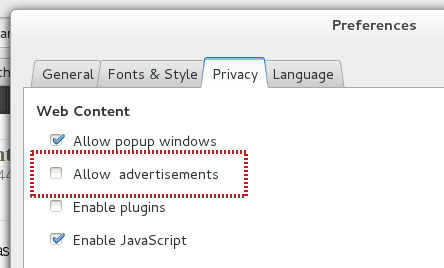
Of course there’s still some things that could be done, like a simple UI to edit the filter rules (for instance, to white-list a particular page where you do want to see ads), but for now we feel this is already a good improvement.
Boston Summit
In other news, I’m just a couple days away from jumping into a plane to attend this year’s Boston Summit. I’m looking forward to see old and new faces and continue the good discussions and work we started in GUADEC about the present and future of GNOME. On the selfish department, I hope to get hold of some lost designer to start fleshing out the 3.8 plans for Web, there’s so much to do.
Thanks to the GNOME Foundation for sponsoring my trip, and to Igalia for allowing me to attend the event!

It’s that time of the year again where we have a look at what happened in the project in the last 6 months. In mere weeks it will be released with the shiny GNOME 3.6 (best.release.ever), but since release notes don’t write themselves here’s a sneak preview of all the new toys in Web-land.
GUADEC has been going on for a few days already, but it is far from over. This is a short post to make some noise about some upcoming BoFs & hackfests that might not receive as much publicity as the rest of the stuff, being outside of the “talks” track.

GNOME as an OS
As announced in our “A bright future for GNOME” talk Juanjo and myself will chair a BoF to talk about the future of GNOME. If you want to get things done and want our project to keep kicking ass for another 15 years (at least!) please come and talk with us next Monday 30th from 10AM, Room 2.1a. We intend to make this BoF productive, constructive and as little bikeshed-y as possible, your cooperation will be welcome!
Epiphany & WebKit hackfest
The might Epiphany and WebKit GNOME hackers will meet again in Room 2.1a on Tuesday 31st to hack, hack and hack. I have already committed to move the all-new Overview forward with Claudio, review the amazing new documentation submitted by Pierre-Yives Luiten, work with William on Data Sync or keep going on recently started secret projects. Some people have already approached me asking for various Ephy-related things (bug triaging, random bugs they want to see fixed), be there if you want to help!
Twitter’s last Privacy Policy Update helpfully informs all users that they do now support the Do Not Track (DNT) browser setting, which aims to stop the collection of information at the user’s request (a collection which Twitter is actively engaged into).
Spurred by all this I sat down and added DNT support in Epiphany, which thankfully is an extremely simple spec to implement. It’s now in master, so anyone willing to enable just needs to go to the Privacy tab in Preferences and click:
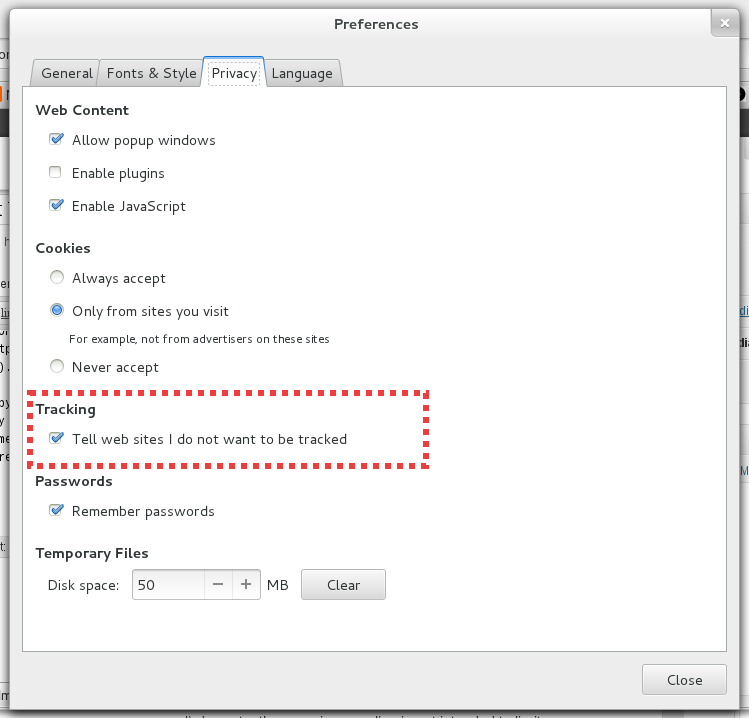
Now the pages that choose to respect this setting (unfortunately not everyone does; by a long shot), should be able to detect your request. We can see that things are working in the donottrack.us page itself.
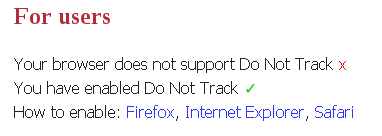
Note that the page claims our browser does not support the feature, yet it is enabled; this is because DNT being an HTTP header extension the only way for the page to tell you whether your browser supports it in theory is by having a hardcoded list of supported browsers, which does not include Epiphany. Oh well. Either way, enjoy your newly untraceable goodness, which should make its way into the next unstable release.
Turns out I’ll get to spend the next two weeks in Tokyo, starting next Sunday. It will be third time I visit this weird and fascinating place, but I’m still excited to be there again.

Some time ago, in another trip, I proposed anyone who might be reading me to meet up and talk about all things GNOME or WebKit. Turns out I met some interesting people that way (hi everyone from Caixa Mágica!), so let’s try again: if you are reading this, are in Tokyo, and would like me to talk to your friends/colleagues/whatever about GNOME or WebKit I’d be happy to do so. We can also improvise a hackfest or anything else we can come up with. In exchange I only ask of you to show me around (always better with a local) and an unwavering commitment to freedom and justice.
Drop me a line at xan AT gnome DOT org, or leave a comment in this space.
This year’s Summer of Code has already started, and Epiphany has been lucky enough to get two students assigned. Let’s see who they are and what they’ll be working on.
GNOME 3.4 is around the corner, and with it a new version of its little web browser that could. This is for sure one of the most action packed releases in a long time, so let’s do a recap of the last 6 months of development.
Previously in this space we saw how the bright future of Epiphany looked like, and vague promises about incremental steps towards it were done. A month later, Epiphany 3.3.4 is out there, so let’s see how well we’ve done.
As you might have heard in many other places a bunch of GNOME and WebKit hackers have met in rainy Coruña for the 3rd WebKitGTK+ hackfest. Many things have been discussed, but today I’m going to give a sneak preview of the new design for Epiphany and its rebirth as the core GNOME Web application.
A few months ago the Apple Store accumulated more than 500,000
approved applications available for download. This is a very
remarkable fact for a relatively new platform using somewhat obscure
technologies. It is, also, a very profitable situation for Apple.