



Memilih permainan taruhan memang harus dipikirkan dengan baik dan benar dan tidak boleh dilakukan dengan sembarangan. Kalaupun ada banyak koleksi permainan yang tersedia tetap kita harus bisa selektif memutuskan dan memilih salah satu pilihan yang paling tepat. Dengan cara demikian inilah yang kemudian akan memungkinkan dan memudahkan kita untuk bisa memperoleh kemenangan. Kita bisa mendapatkan dan memperoleh kemenangan lebih mudah dari permainan yang kita lakukan jika kita bisa bermain dengan cara yang tepat.
Planet maemo

New year, new job. After leaving Canonical I'm back to working on the same software platform on which I started working back in 2006: Maemo. Well, not exactly the vanilla Maemo, but rather its evolution known as Aurora OS, which is based on Sailfish OS. This means I'm actually back to fixing the very same bugs I introduced back then when I was working in Nokia, since a lot of the middleware has remained the same.
At the moment OMP (the company developing Aurora OS) is mostly (or even exclusively, AFAIK) targeting business customers, meaning corporations such as the Russian posts and the railway company, whereas the consumer market is seen as something in the far away future. Just in case you were curious whether there were any devices on sale with Aurora OS.
I should also explain why I've refused several very well paying job opportunities from Western companies: it's actually for a reason that has been bothering me since last March, and it's a very simple one. The fact is that because of the sanctions against Russia I already had to change bank once (as the one I was using fell under sanctions), and in these months I've always been working with the fear of not being able to receive my salary, since new sanctions are introduced every month and more and more banks are being added to the blacklist. That's why I've restricted my job search to companies having an official presence in Russia; and to my surprise (and from some point of view, I could even say disappointment) the selection and hiring processes were so quick that I received three concrete offers while I was still working my last weeks at Canonical, and I joined OMP on that very Monday after my last Friday at Canonical.
I mean, I could have rested a bit, at least until the Christmas holidays, but no. ☺ Anyway, I'm so far very happy with my new job, and speaking Russian at work is something totally new for me, both challenging and rewarding at the same time.

It’s been 8 years since the last time I wrote a videogame just for personal fun. As it’s now become a tradition, I took advantage of the extra focused personal time I usually have on the Christmas season and gave a try to Processing to do my own “advent of code”. It’s a programming environment based on Java that offers a similar visual, canvas-based experience to the one I enjoyed as a child in 8 bit computers. I certainly found coding there to be a pleasant and fun experience.
So, what I coded is called Cat’s Panic, my own version of a known arcade game with a similar name. In this version, the player has to unveil the outline of a hidden cute cat on each stage.
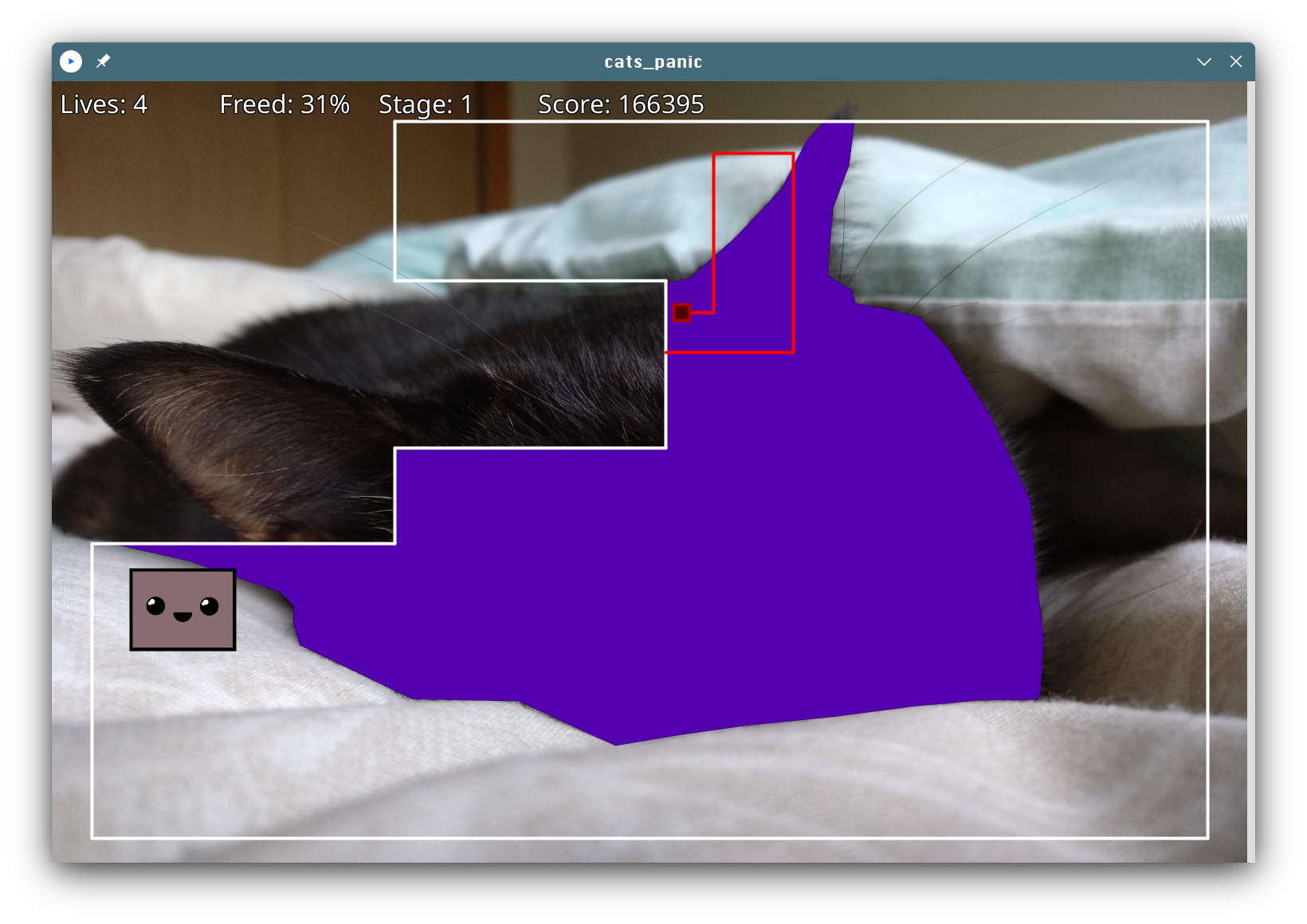
The player uses the arrow keys to control a cursor that can freely move inside a border line. When pressing space, the cursor can start an excursion to try to cover a new area of the image to be unveiled. If any of the enemies touches the excursion path, the player loses a life. The excursion can be canceled at any time by releasing the space key. Enemies can be killed by trapping them in a released area. A stage is completed when 85% of the outline is unveiled.
Although this game is released under GPLv2, I don’t recommend anybody to look at its source code. It breaks all principles of good software design, it’s messy, ugly, and it’s only purpose was to make the developing process entertaining for me. You’ve been warned.
I’m open to contributions in the way of new cat pictures that add more stages to the already existing ones, though.
You can get the source code in the GitHub repository and a binary release for Linux here (with all the Java dependencies, which weight a lot).
Meow, enjoy!

In this post I want to take a look at the Logitech M720 mouse after having used it for 2.5 years.
GNOME Open Desktop Ratings is the service that enables user ratings in various Linux app stores like the Snap-Store, Gnome Software and KDE Discover.
While it nowadays works for users by providing a mostly useful star rating, from a application developer perspective the story is very grim.
Basically one only gets the users view, which provides an average rating and some reviews in the current locale.
This means you might see something like “2 Stars from 80 Reviews” – but the 3 reviews in your current locale are all 4-5 Star.
To see something else you have to change the locale and restart the app store – which is inconvenient and confusing.
As a developer, seeing the negative reviews is crucial, as people often just post bug reports there and this is the only way to find out why the app did not work for them.
Therefore I quickly hacked together a web-based browser for the ODRS service, skillfully named
ODRS BrowserThis allows accessing the ODRS service from the web and shows the reviews from multiple locales at once. The idea here is that often people write reviews in english – regardless of their current locale. Currently, ODRS has no logic to detect that.
Also, if your app is packaged in different formats like snap and flatpack and deb, you can see the reviews of all variants in the overview.
Unfortunately, ODRS currently does not set the CORS header which prevents browsers from accessing it directly. The data that you see right now was scraped with python script. But once this issue is fixed, the ODRS Browser will be able to use live data.
Lets say you want to debug a python process that is either already running or crashing in native code. Pythons PDB is of no help here and you will have to use low-level GDB debugger. Fortunately, it comes with support for debugging high level python scripts.
However, while the actual python-gdb commands are nicely described here, that page lacks important details on how to get python-gdb in the first place. We are merely told that a python-gdb.py is needed.
On Ubuntu/ Debian, this file is included in the python3-dbg package:
sudo apt install python3.10-dbgInstalling that is sufficient, if you use the matching python3 package. You can go ahead and connect to some running python process via:
gdb -p <PID>
# verify that the script is loaded
(gdb) info auto-load
# get a python backtrace
(gdb) py-bt
Traceback (most recent call first):
  File "/usr/lib/python3.10/selectors.py", line 416, in select
    fd_event_list = self._selector.poll(timeout)
  File "/usr/lib/python3.10/socketserver.py", line 232, in serve_forever
...
In case Ubuntu is merely a host and you use coda, you can still use the host python-gdb.py – even if the python versions dont match. You will have to load the script manually though like:
(gdb) source /usr/share/gdb/auto-load/usr/bin/python3.10-gdb.py
Before you get angry at me for this title, please let me state that I count myself in the number of the “idiots” and, secondly, that what I mean by “idiotism” here is not to be intended as an offence, but as some traits of mindset which are typical of very logical brains.
If you have been writing C++ classes for mocking out your C or C++ dependencies, you know how tedious it is. I generally write small classes with just a handful of methods, so it's generally bearable, but when using third-party code I'm usually not that lucky. If the dependency is a C library this becomes especially tricky, both because they might be larger than what you can handle, and both because the lack of an object-oriented design might not offer you an easy solution to store the mock object data.
While older SteamOS releases used to map the right trigger to the left mouse button by default, in current SteamOS you can only click by using the touchpad. However due to the way you hold the device it is really fiddly – especially if you try to drag and drop something.
Fortunately, there is a way to fix this via a setting in Steam. For this you need launch Steam when in Desktop Mode. There, switch to big picture mode and go to
Settings > Base configuration > Desktop Configuratiom
In this view you can configure the inputs to your liking
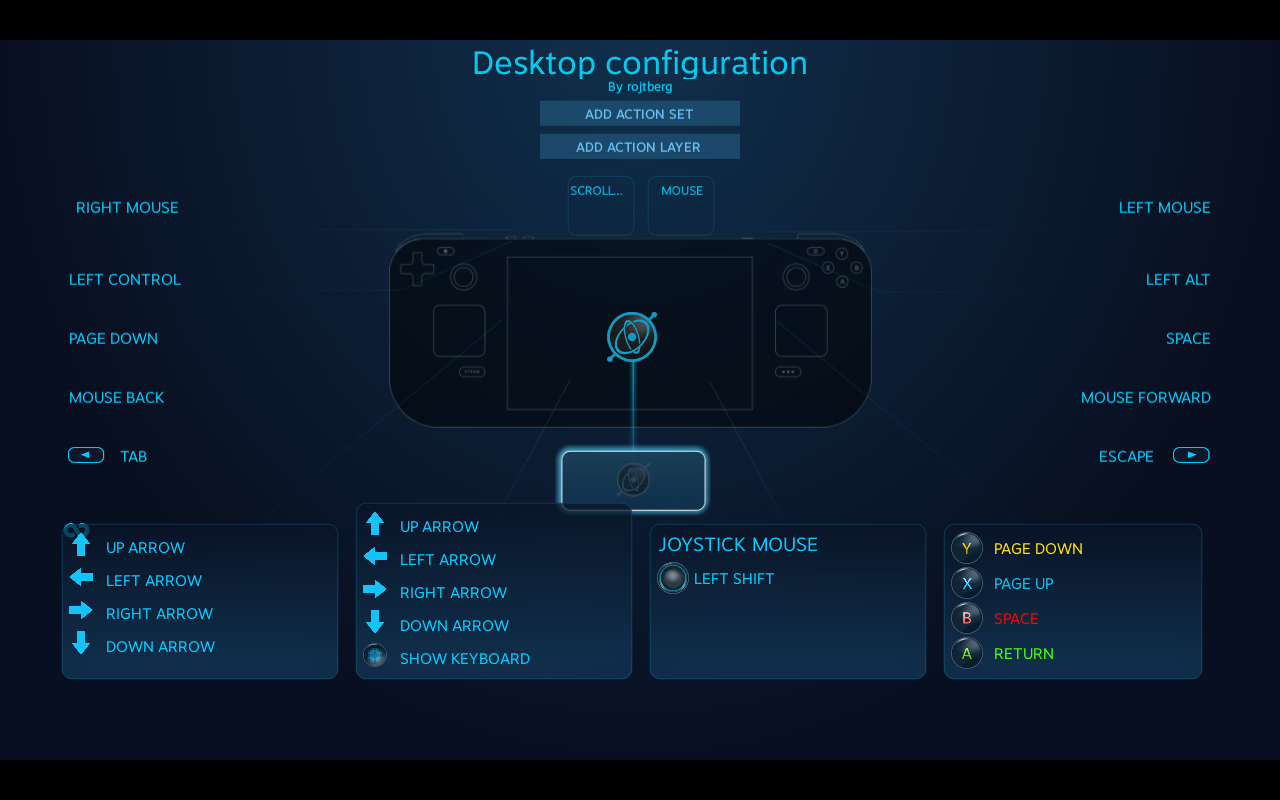 My final configuration
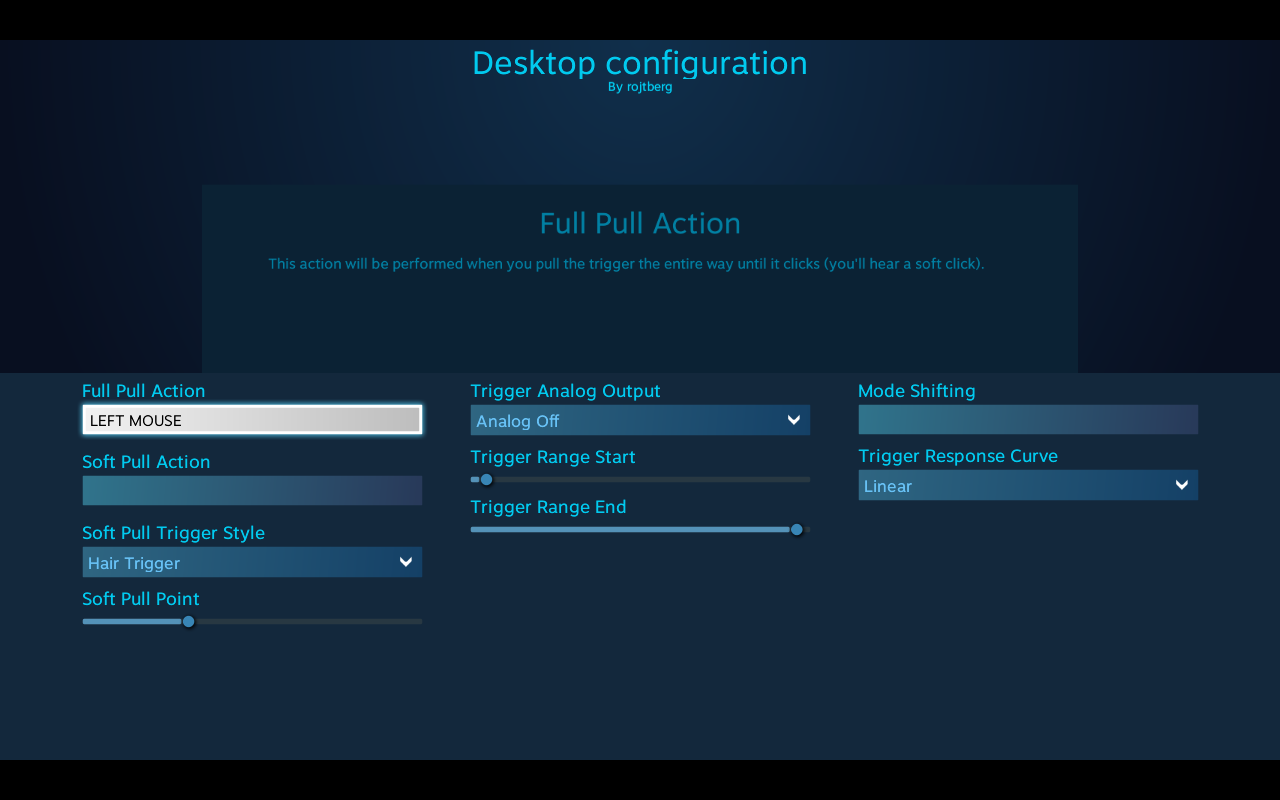 Trigger to click
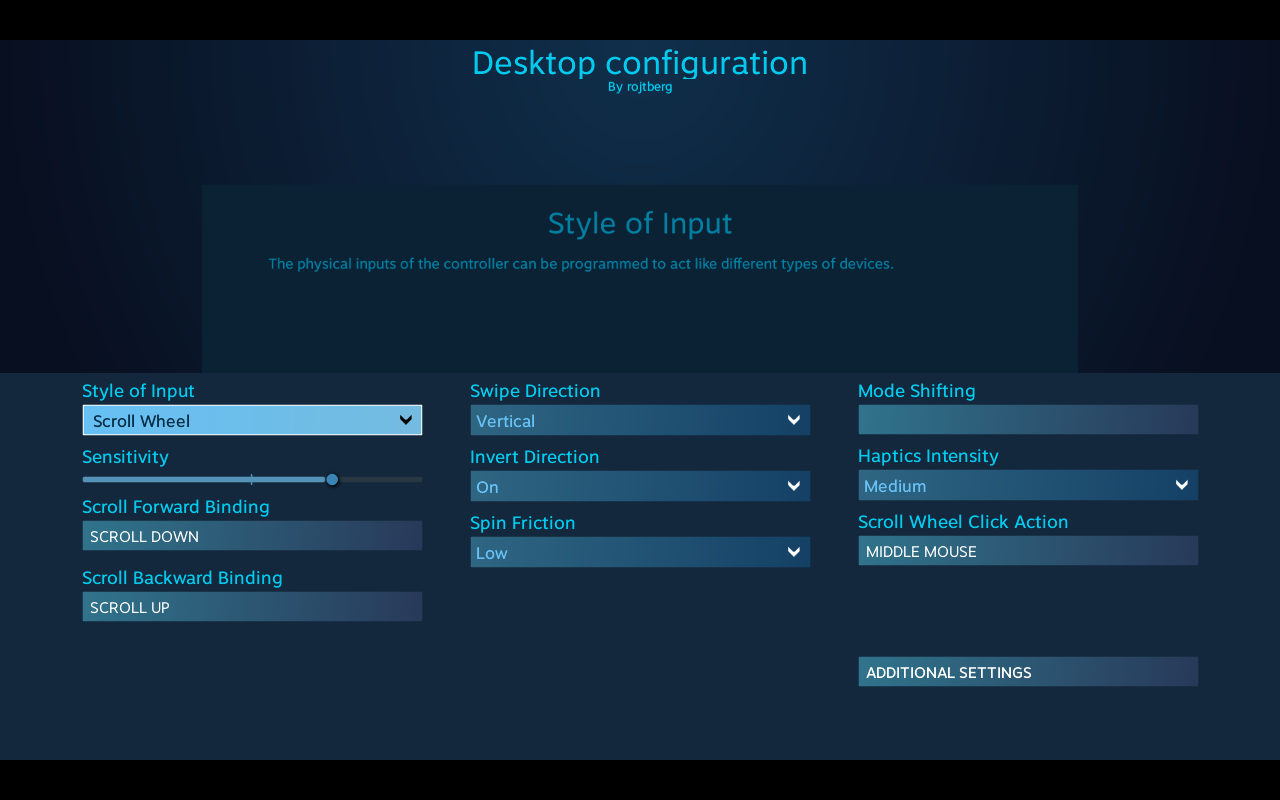 Left touchpad for scrolling
I suggest you to go with the following setup
- Right trigger for left click (sounds counter-intuitive, but works well)
- Left trigger for right click
- Left touchpad for moving the mouse (doh)
- Right touchpad for scroll wheel
With this configuration you can use the desktop mostly pain-free.
The SLURM documentation provides you with the basic information that you can use Docker withing SLURM – as long as you use rootless Docker. However some crucial pieces are missing.
The issue that you will immediately run into is that the SLURM resource allocation is not propagated to docker at all. E.g. if you start your job with srun --gpus 1 docker ... all GPUs will be available to docker nevertheless.
The issue here is that Docker uses a manager daemon that the docker CLI communicates with. And that daemon does not know anything about SLURM or any resources it allocated for the job.
The solution is to start a daemon per job (instead of per user) as one user might want to run different jobs with different allocations on the same machine. The docker documentation gives you an idea on how to do that.
You will need to set at least the following parameters to make the daemon fully job-specific
# dockerd-rootless.sh requires XDG_RUNTIME_DIR
XDG_RUNTIME_DIR=/somewhere/including/$SLURM_JOB_ID
# export, so docker client sees it later on
export DOCKER_HOST=unix://$XDG_RUNTIME_DIR/docker.sock
dockerd-rootless.sh --host=$DOCKER_HOST --data-root=... --exec-root=...
Here, exporting DOCKER_HOST makes the docker CLI use the correct daemon.
The drawback of this method is that each job needs to pull the container again due to the separate data-root paths. Switching to podman might solve that.
If you, like me, went with the entry level Steam Deck option with only 64 GB of internal storage, you likely realized quite soon that some games wont fit on it.
One option is to use the microSD expansion card slot. For current-gen games the throughput of only about 150 MB/s does not seem to degrade loading performance compared to a NVMe SSD.
However, given that the internal storage is upgradable, the only logical choice for keeping your PC master race status is to cram in the fastest NVME SSD inside that thing.
Specifically, you will need a one-sided SSD in the M.2 2230 for factor so it fits the space inside the Steam Deck.
I went with the KIOXIA Client-SSD BG5 512GB. Kioxia is the Toshiba spin-off for SSD drives, if you wonder about the brand. Although it is a PCIe 4.0 drive, its peak read throughput of 3.5 GB/s is within the practical limits of PCIe 3.0 of the Steam Deck.
Also, the active power consumption of 4.1W is quite close to the 3.8W drawn by the custom PHISON PS5013 E13 SSD that Valve uses.
You can follow the iFixit Guide for the steps to actually swap the SSD. Make sure to transfer the ESD shielding wrap to the new SSD.
To get Steam OS on the new drive, follow the official recovery instructions and select the “Re-image Steam Deck” script.
This will install Steam OS on the blank SSD – similar to how you would install Ubuntu from a live USB.
Benchmarking results
Next, I wanted to actually compare the speed of the upgraded NVMe SSD with the one of the stock eMMC memory. To this end I used KDiskMark – an open-source alternative to CrystalDiskMark that runs on Linux natively.
The tests were performed on SteamOS 3.3.1 using KDiskMark 2.3.0.
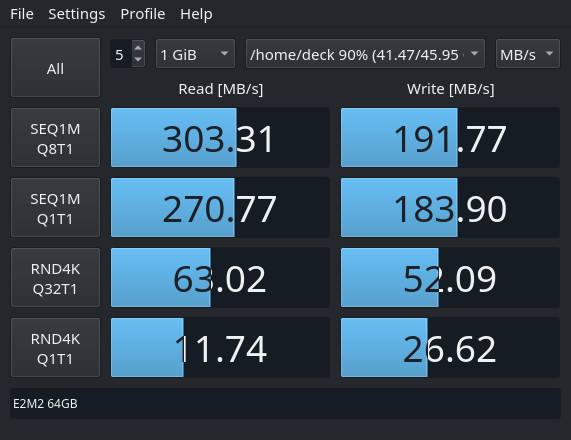 eMMC
eMMC
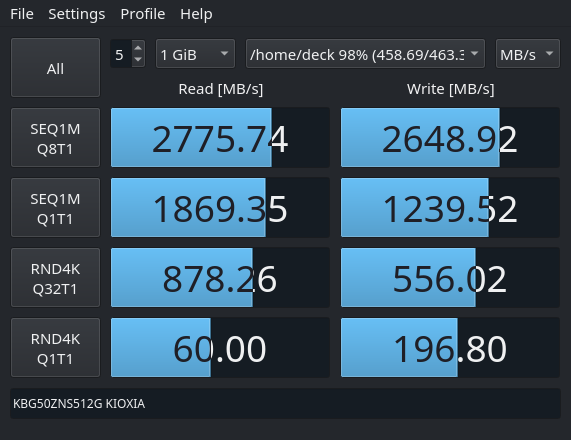 NVMe
The median of 3 KDiskMark runs
NVMe
The median of 3 KDiskMark runs
In short, the NVME offers roughly one order of magnitude faster throughput over the eMMC.
Whether you feel this in-game, highly depends on the given game. For older titles, even the eMMC is so fast, that you cannot read the hints on the loading-screen. However, for something like the Flight Simulator 2020 that shuffles huge assets around, it will surely be noticeable.
Finally, the peak read performance of 3.5GB/s is not reached. This might be due to the PCIe 3.0 bottleneck – I did not bother putting the drive in a PCIe 4.0 device. Still, there is a significant advantage in writing performance over the older Kioxia BG4 series, that only do 1.4 GB/s.
TLDR; command at the end of post
If you want a equal loudness for your Music library the go to solution and the de-facto standard is ReplayGain.
If you are using a music streaming service, the provider is typically taking care of that for you – but maybe you want to migrate towards your own streaming solution.
ReplayGain analyses your audio files and stores their deviation from the baseline loudness as a tag. A compatible audio player can then read the tag and correct the playback volume so all you tracks have the same loudness.
Of course things get messy once you look at details like what the baseline loudness should be and how to determine loudness in the first place. Therefore we set the baseline once and for all as 89db and consider even tracks of the same album individually. If you disagree, feel free to branch off reading up the details now.
The next issue is that ReplayGain was born in a time where mp3 was synonymous to digital music, hence the algorithm was first implemented as the mp3gain CLI tool. Nowadays you also need aacgain and vorbisgain to cover all your formats, which is cumbersome to automate.
The larger issue with ReplayGain is that it defines loudness of a track by its peak volume. While a sane choice in theory, in practice the music and advertising industries raced to increase the perceived loudness without raising the peak volume. As broadcasters also used peak volume normalization, one could blow your eardrum with that very special advertisement.
Therefore the EBU R 128 was proposed which at its core is RMS based, meaning it is considering the average volume of the track.
Remember that ReplayGain merely adds a correction value to the tracks? This allows us to compute that correction value based on the R128 algorithm for a better normalization, which is exactly what the <a href="https://github.com/desbma/r128gain">r128gain</a> tool does.
Being written in modern day, r128gain also processes all possible audio files by hooking into ffmpeg as a filter.
So, without further ado, this is the command to normalize your Music library:
# pip3 install r128gain
r128gain -p -r Music/
This will preserve "-p" the file timestamps and recursively "-r" process all files in the given directory.
Trouble shooting
Note that if you previously used mp3gain, your files might contain non-standard lower-case replaygain_* tags, while r128gain will only write REPLAYGAIN_* tags.
To avoid confusing players with different values, you should remove the non-standard tags. This can be automated with eyeD3
eyeD3 -Q --remove-frame RGAD --preserve-file-times --user-text-frame=replaygain_track_gain: --user-text-frame=replaygain_track_peak: --user-text-frame=replaygain_album_gain: --user-text-frame=replaygain_album_peak: Music/Refer to its documentation for the meaning of the parameters. For RGAD see here.
Header Image: “volume” by christina rutz (CC-BY-2.0)