Planet maemo: category "feed:b1704e4f997dfb2448842ae2dc57ed3f"

Marius Gedminas

Latin-1 or Windows-1252?

2010-01-07 21:42 UTC  by  Marius Gedminas
0
0

Michael Foord wrote about some Latin-1 control character fun in a blog that's hard to read (the RSS feed syndicated on Planet Python is truncated, grr!) and hard to reply (no comments on the blog! my Chromium's AdBlock+ hid the comment link so I couldn't find it), but never mind that.

Unfortunately the data from the customers included some \x85 characters, which were breaking the CSV parsing.

0x85 is a control character (NEXT LINE or NEL) in Latin-1, but it's a printable character (HORIZONTAL ELLIPSIS) in Microsoft's code page 1252, which is often mistaken for Latin-1. I would venture a suggestion that the encoding of the customer data was not latin-1 but rather cp1252.

>>> '\x85'.decode('cp1252')
u'\u2026'
Marius Gedminas

GTimeLog: not dead yet!

2009-12-18 00:58 UTC  by  Marius Gedminas
0
0

Back in 2004 I wrote a small Gtk+ app to help me keep track of my time, and called it GTimeLog. I shared it with my coworkers, put it on the web (on the general "release early, release often" principles), and it got sort-of popular before I found the time to polish it into a state where I wouldn't be ashamed to show it to other people.

Fast-forward to 2008: there are actual users out there (much to my surprise), I still haven't added the originally-envisioned spit and polish, haven't done anything to foster a development community, am wracked by guilt of not doing my maintainerly duties properly, which leads to depression and burnout. So I do the only thing I can think of: run away from the project and basically ignore its existence for a year. Unreviewed patches accumulate in my inbox.

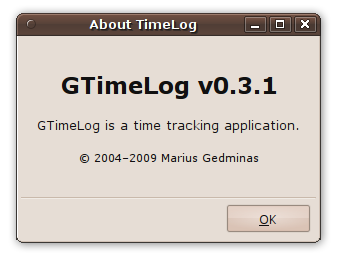
It seems that the sabbatical helped: yesterday, triggered by a new Debian bug report, I sat down, fixed the bug, implemented a feature, applied a couple of patches languishing in the bug tracker, and released version 0.3 (which was totally broken thanks to setuptools magic that suddenly stopped working; so released 0.3.1 just now). Then went through my old unread email, created bugs in Launchpad and sent replies to everyone. Except Pierre-Luc Beaudoin, since his @collabora.co.uk email address bounced. If anyone knows how to contact him, I'd appreciate a note.

version is now shown in the about dialog

There are also some older changes that I made before I emerged out of the funk and so hadn't widely announced:

  • There's a mailing list for user and developer discussions (if there still are any ;).
  • GTimeLog's source code now lives on Launchpad (actually, I mentioned this on my blog once).
Marius Gedminas

Unix is an IDE, or my Vim plugins

2009-12-08 23:37 UTC  by  Marius Gedminas
0
0

Unix is an IDE. I do my development (Python web apps mostly) with Vim with a bunch of custom plugins, shell (in GNOME Terminal: tabs rule!), GNU make, ctags, find + grep, svn/bzr/hg/git.

Click to read 1152 more words
Marius Gedminas

Displaying multiline text in Zope 3

2009-12-01 18:57 UTC  by  Marius Gedminas
0
0

zope.schema has Text and TextLine. The former is for multiline text, the latter is for a single line, as the name suggests. Zope 3 forms will use a text area for Text fields and an input box for TextLine fields. Display widgets, however, apply no special formatting (other than HTML-quoting of characters like <, > and &), and since newlines are treated the same way as spaces in HTML, your multiline text gets collapsed into a single paragraph.

Here's a pattern I've been using in Zope 3 to display multiline user-entered text as several paragraphs:

import cgi

from zope.component import adapts
from zope.publisher.browser import BrowserView
from zope.publisher.interfaces import IRequest


class SplitToParagraphsView(BrowserView):
    """Splits a string into paragraphs via newlines."""

    adapts(None, IRequest)

    def paragraphs(self):
        if self.context is None:
            return []
        return filter(None, [s.strip() for s in self.context.splitlines()])

    def __call__(self):
        return "".join('<p>%s</p>\n' % cgi.escape(p)
                        for p in self.paragraphs())

View registration

<configure
    xmlns="http://namespaces.zope.org/zope">

  <view
      for="*"
      name="paragraphs"
      type="zope.publisher.interfaces.browser.IBrowserRequest"
      factory=".views.SplitToParagraphsView"
      permission="zope.Public"
      />

</configure>

and usage

<p tal:replace="structure object/attribute/@@paragraphs" />

Update: The view really ought to be registered twice: once for basestring and once for NoneType. I was too lazy to figure out the dotted names for those (or check if zope.interface has external interface declarations for them), so I registered it for "*". You should know that this makes the view available for arbitrary objects (but won't work for most of them, since they don't have a splitlines method), and that it is, sadly, accessible to users who may try to hack your system by typing things like @@paragraphs in the browser's address bar. Ignas Mikalajūnas offers an alternative solution using TALES path adapters.

Marius Gedminas

I booked a stay at a particular hotel because the web page said "Free WiFi". It didn't say "all outgoing ports firewalled except for port 80 and a few other (useless) ones". Not having SSH access is most painful. Luckily, there's a solution.

You need a web server running Apache and SSH. Enable mod_proxy and mod_proxy_connect and add this to the first (i.e. default) virtual host configuration:

<VirtualHost whatever:80>
...

  # allow ssh to localhost over http proxy
  ProxyRequests on
  AllowCONNECT 22
  <Proxy localhost>
    Order allow,deny
    Allow from all
  </Proxy>

</VirtualHost>
Reload Apache configuration. The setup is done. (Instructions based on Tunneling SSH over HTTP(S) by Dag Wieers.)

On the client side you need proxytunnel. Sadly, it's not packaged for Ubuntu yet, but compiling from sources is trivial. Edit ~/.ssh/config and add an entry for your proxied ssh connection:

Host pmyservername
ProxyCommand proxytunnel -q -p myserver.mydomain.com:80 -d localhost:22

That's it. Now you can ssh pmyservername. (The p prefix is a reminder that I'm using a proxied connection: ssh fridge versus ssh pfridge. Also it reminds me of Terry Pratchett's Pyramids.).

For extra fun (e.g. IRC) use ssh's built-in SOCKS5 proxy: ssh -D 1080 pmyservername. Then tell the apps to use a SOCKS5 proxy on localhost. Since telling each app to use a proxy (and then, later, telling it to stop using it) is a big *pain*, and some apps (e.g. ssh) don't support proxies directly, a wrapper like tsocks is handy. Edit /etc/tsocks.conf and set the default socks server to 127.0.0.1, then use it to run apps:

$ tsocks xchat-gnome
$ tsocks bzr push lp:myprojectname

tsocks is packaged for Ubuntu.

If your hotel doesn't have free WiFi, a prepaid SIM card with 3G access could be cheaper than roaming charges. Apparently you can get one with a virtually unlimited (for a short stay, anyway) data plan for 27 EUR in Amsterdam.

Marius Gedminas

Pylons and SQL schema migration

2009-09-21 17:38 UTC  by  Marius Gedminas
0
0

I'm at the point in my hobby project where I'd like to be able to change my models without losing all my test data. And I'm too lazy to do manual dumps and edit the SQL in place before reimporting it.

I want a system

  • that is transparent to the user: if my database is at schema version 1, and my code is at version 3, I want it to be automatically upgraded to version 3 on server startup.
  • that is not too hard on the programmer: dropping a numbered Python or SQL script in a directory ought to be sufficient to define a transition from schema version X to schema version X+1.
  • that handles errors gracefully: makes a backup of the database with the old schema version; runs my script in a transaction and aborts that transaction if the conversion fails (while showing me enough information to debug the problem).
  • allows prototyping without having to increment the schema number for every little change I make to the models; I should be the one who decides that a new schema is ready to go out to the world.

I've been glancing at SQLAlchemy-Migrate, since I've been brought up to believe NIHing is Bad. But Migrate is scary. I have to admit that the longer I stare at its documentation, the less I can describe why I think so. All those shell commands—but there's an API for invoking them from Python, so maybe I can achieve my goals. I'll have to try and see.

Marius Gedminas

Pylons with zc.buildout, continued

2009-09-15 20:40 UTC  by  Marius Gedminas
0
0

Last time I mentioned that running bin/buildout with the -N flag makes it run faster (since it skips looking for newer versions to upgrade). You can tell buildout to do this by default by putting 'newest = false' into the [buildout] section of buildout.cfg. We'll be running bin/buildout a lot now, since we'll be making changes to the project environment, so this will save wear and tear on the '-', 'N' and Shift keys. (And, by the way, I'm not trying to soak up Google juice by repeating the word 'buildout' a lot, honest!)

Click to read 1386 more words
Marius Gedminas

Starting a Pylons project with zc.buildout

2009-09-13 13:37 UTC  by  Marius Gedminas
0
0

For software development I prefer buildout to virtualenv. This is because buildout has a text file describing the state of your working environent, which can be versioned and used later to recreate it, as well as during development to modify the environment slightly.

Click to read 1642 more words
Marius Gedminas

Footnotes done well

2009-09-11 23:42 UTC  by  Marius Gedminas
0
0

I like the way footnotes are implemented here: Snakes on the Web by Jacob Kaplan-Moss.

mini-screencast of animated footnote

(Recorded with byzanz. My gif-fu is nonexistent or I would make it loop, but with a sufficiently long delay at the end to avoid irritation. Now you have to reload the whole page if you missed the animation.)

I'm somewhat ambivalent about the animation effect. On one hand, shiny! On the other hand, hitting tiny clickable areas is not good usability. Still, shiny!

Footnotes are kind of a personal pet-peeve of mine.

Marius Gedminas

Local changes to buildout.cfg

2009-08-03 17:38 UTC  by  Marius Gedminas
0
0

Most of Python packages in the Zope world use Buildout:

svn co svn+ssh://svn.zope.org/repos/main/plone.z3cform/trunk plone.z3cform
cd plone.z3cform
python2.4 bootstrap.py
bin/buildout
bin/test -pvc

Now suppose you want to change the buildout environment somehow, e.g. use the current development version of zope.testing instead of whatever is specified in buildout.cfg. Don't edit the existing buildout.cfg (you might accidentally commit your local debug changes), instead create a new cfg file, e.g. test.cfg:

[buildout]
extends = buildout.cfg
develop += ../zope.testing

[versions]
# override any existing version pins
zope.testing =

Now re-run buildout

bin/buildout -c test.cfg
bin/test -pvc

And the tests should be run with the newest zope.testing.code.

Only this does not work with plone.z3cform, and I have no clue why. It generally works with other packages (at least those that use the zc.recipe.testrunner rather than collective.recipe.z2testrunner). Buildout is like that sometimes :(

Marius Gedminas

Went to EuroPython, met new people, had a great time.

Updated gtkeggdeps, the interactive Python package dependency browser. Collaborated with Thomas Lotze, who maintains the engine (tl.eggdeps) that gtkeggdeps wraps, to resolve API mismatches. Moved the sources to launchpad.net, added a test suite, made it use zc.buildout for convenient development.

Moved the source repository of gtimelog, the simple desktop time tracker, to launchpad.net. Failed to do anything else with it. :-(

Tried to work on xdot, wrestled with git-svn merges, failed abysmally. Asked upstream to upload xdot to PyPI.

Released ZODB Browser, but this deserves a separate post.

Sent a bunch of pyflakes patches from my old branch upstream, created trac tickets for the rest. Wrestled with bzr-svn merges, failed abysmally.

Marius Gedminas

df

2009-07-14 22:38 UTC  by  Marius Gedminas
0
0

Modern Linux system have all sorts of fake filesystems cluttering the output of df and mount: tmpfs, bind mounts, fuse for ~/.gvfs, etc. I have only one real partition on my laptop, yet mount returns 22 lines of output.

Question: are there any df-like utilities that filter out all the crap and show only interesting bits? The standard df as well as pydf both display 8 lines instead of 1. Discus is worse: it shows 20. GUI utilities like Baobab also suffer from this confusion, especially bind mounts.

Ironically, Ubuntu's update-motd gets confused by Ubuntu's private user directories and displays disk stats for ~/Private as if it were a real partition.